Businesses that regularly move goods temporarily across international borders are about to see one of the biggest changes to the ATA Carnet system in decades.
From 1 June 2026, digital ATA Carnets will officially go live across the UK, European Union, Norway and Switzerland. This marks the beginning of a major international modernisation programme led by the International Chamber of Commerce (ICC) and the World Customs Organization (WCO).
For importers, exporters, exhibitors, engineers, technicians and companies transporting professional equipment overseas, the move to digital promises a faster and more efficient process. However, there will also be a transition period where both paper and digital Carnets operate together, creating some additional planning requirements for businesses.
Table of Contents
What Is an ATA Carnet?
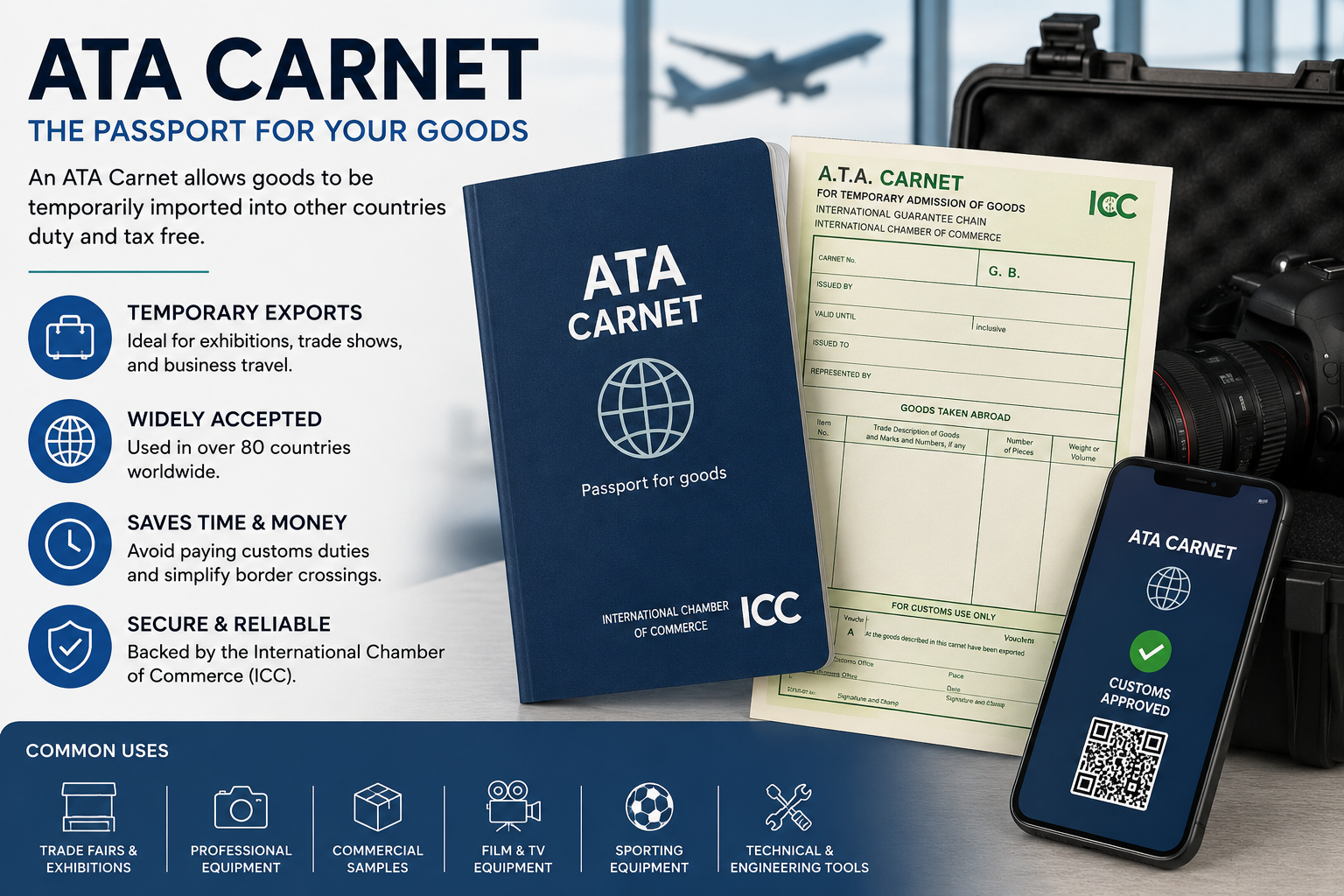
An ATA Carnet is an international customs document that allows goods to be temporarily imported into participating countries without paying import duty or taxes.
They are commonly used for:
- Trade fairs and exhibitions
- Professional equipment
- Commercial samples
- Demonstration products
- Film and television equipment
- Sporting equipment
- Technical and engineering tools
The Carnet acts as a passport for goods and can be used across more than 80 participating countries. Instead of paying customs charges each time goods enter a country, businesses can use a single document to cover temporary movements.
Why Are ATA Carnets Going Digital?
The traditional Carnet process relies heavily on paper documents that must be presented and stamped at every customs checkpoint.
While the system works well, businesses have long faced challenges such as:
- Lost or damaged documents
- Administrative delays
- Manual customs processing
- Limited visibility of movements
- Additional courier costs when replacements are needed
Digital ATA Carnets are designed to solve many of these issues. The new system will allow Carnet holders to manage declarations electronically through the ATA Carnet App or desktop platform. Customs officers will process transactions by scanning QR codes rather than physically endorsing paper vouchers.
The wider objectives include:
- Reducing paperwork
- Improving customs visibility
- Speeding up border processing
- Lowering administrative costs
- Reducing the risk of document loss
- Supporting more sustainable operations
The Key Date: 1 June 2026
The official live launch date for digital ATA Carnets is 1 June 2026.
From this date, the UK, all EU member states, Norway and Switzerland will begin operating digital Carnet procedures. This represents the first major phase of a wider global rollout.
Businesses using Carnets after this date should expect changes to how their temporary exports are managed.
The application process itself remains largely unchanged. Businesses will continue applying through their issuing Chamber of Commerce or Carnet provider. Once approved, users will receive a Carnet ID and PIN that can be loaded into the ATA Carnet App.
Paper and Digital Carnets Will Coexist
One important point for businesses is that the move to digital will not happen overnight.
There will be a transition period during which both paper and digital Carnets can be used together. This is because not all Carnet countries will move to the digital system at the same time.
The type of Carnet issued will depend on the countries included in your itinerary.
Paper-only destinations
If all destinations on your itinerary still operate paper Carnets, you will continue using a traditional paper Carnet exactly as you do today.
Digital-only destinations
If all destinations support digital Carnets, you will receive a digital Carnet and use the ATA Carnet App to manage customs transactions through QR code scanning.
Mixed itineraries
This is where many businesses will need to pay close attention.
If your trip includes both digital and non-digital countries, you may receive both formats. You will need to present the correct version depending on the customs authority involved.
For example, a business travelling from the UK to Germany and then onward to a country that has not yet adopted digital Carnets may need to use both systems during the same journey.
At Barrington Freight, we specialise in making your importing and exporting straightforward. From customs clearance to finding the right commodity codes, our expert team is here to assist. Don’t let the complexities of global trade hold you back. Reach out to Barrington Freight for efficient and reliable shipping solutions.
How Will the Digital Process Work?
The new process is designed to be straightforward.
Typical steps include:
- Apply for the Carnet through your issuing body.
- Receive a Carnet ID and PIN.
- Download the ATA Carnet App.
- Load your Carnet into the app.
- Prepare travel declarations before departure.
- Present QR codes at customs checkpoints.
- Customs officers scan and validate the movement electronically.
The digital record is then stored within the system, creating a clearer audit trail for both businesses and customs authorities.
What Businesses Should Do Now
Companies that regularly use ATA Carnets should begin preparing immediately.
Recommended actions include:
- Familiarise staff with the ATA Carnet App
- Review upcoming temporary export movements
- Check which destination countries support digital Carnets
- Train employees and representatives who travel with Carnet goods
- Understand how mixed paper and digital itineraries will work
- Allow additional time for border crossings during the early stages of implementation
Many issuing chambers are already encouraging businesses to test digital Carnets alongside existing paper procedures to gain practical experience before widespread adoption.
Practical Considerations for Freight Forwarders and Exporters
From a freight forwarding perspective, the transition should eventually reduce paperwork and improve efficiency. However, the early stages are likely to create some operational challenges.
At Barrington Freight, we expect businesses moving exhibition equipment, demonstration machinery and professional equipment across Europe to encounter a learning curve during the first few months.
The biggest risk is assuming every destination will operate the same way. During the transition period, businesses must carefully check the requirements for every country on their route before departure.
A single non-digital country can affect the documentation required for the entire movement. Planning ahead will be essential to avoid delays at customs checkpoints.
Companies should also ensure that the people physically travelling with the goods understand which format must be presented at each stage of the journey.
The Long-Term Future of ATA Carnets
The move to digital Carnets is part of a wider international customs modernisation programme.
Current plans indicate that the remaining Carnet countries will progressively adopt the digital system over the next two years, with broader global implementation expected by 2028.
Once fully implemented, businesses should benefit from:
- Faster customs processing
- Reduced administration
- Greater visibility of movements
- Improved security
- Lower risk of document loss
- More efficient international temporary exports
For businesses that regularly attend trade shows, carry out overseas demonstrations or move professional equipment internationally, digital ATA Carnets represent a significant step towards simpler cross-border trade.
Final Thoughts
The launch of digital ATA Carnets on 1 June 2026 is a major milestone for international trade.
While the long-term benefits are clear, businesses should remember that the transition period means paper and digital Carnets will operate side by side for some time. Understanding which format applies to each destination will be critical.
For companies planning temporary exports in the coming months, early preparation will help avoid delays and ensure a smooth transition as customs authorities across Europe and beyond move towards a fully digital Carnet system.
Need an ATA Carnet?
If you’re planning a temporary export and need an ATA Carnet, Barrington Freight can help. Our experienced team can guide you through the application process, explain the latest digital Carnet requirements, and ensure your goods travel internationally with minimal customs delays.
Get in touch with Barrington Freight today for expert advice and support with your ATA Carnet requirements.
About the Author
Simon Poole began his career in production planning, quickly rising to manage 24-hour manufacturing lines and oversee a team of 140 staff. In 2007, he joined Barrington Freight, where he brought his operational expertise into the logistics sector. Appointed Operations Director in 2021, Simon now leads all day-to-day operations, including sea, air and European freight, working closely with clients and partners worldwide.




Need help with your freight?
Contact Barrington Freight for a personalised consultation. We offer fast, reliable freight forwarding for businesses across all industries – by road, air or sea.